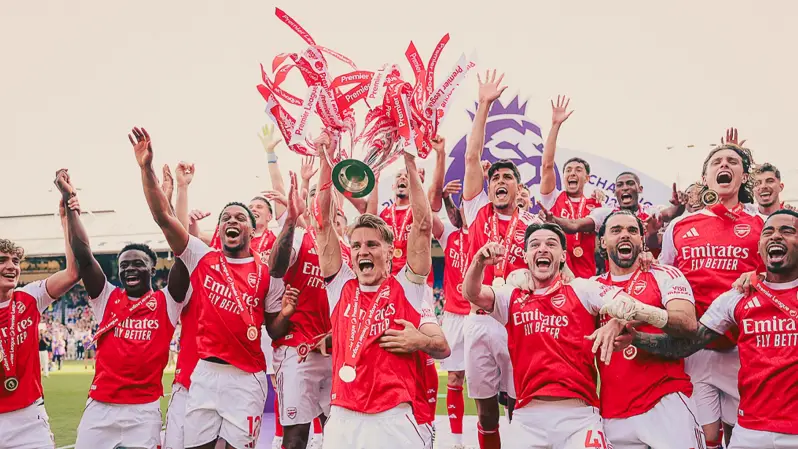
The 2025/26 Premier League season delivered one of the most dramatic and unpredictable campaigns in recent memory, featuring a title triumph for Arsenal, a chaotic relegation battle, surprise European challengers, and the collapse of several traditional powers. From the very first weekend to the final whistle on matchday 38, the league rarely followed expectations.
Arsenal emerged as champions after an outstandingly consistent campaign under Mikel Arteta. The Gunners finished on 85 points, seven clear of Manchester City, winning 26 of their 38 matches while scoring 71 goals and conceding just 27 — comfortably the best defensive record in the division. Unlike previous years where Arsenal faltered during the spring, this time they held their nerve magnificently, ending the season with five consecutive victories to secure the title in style. Their balance across the pitch proved decisive: disciplined defensively, creative in midfield, and clinical in attack. While they may not have produced the overwhelming dominance of some recent champions, Arsenal were unquestionably the most complete and reliable side over the course of the season.
Manchester City’s campaign felt strangely subdued by their extraordinary standards. Despite scoring a league-high 77 goals and losing only six matches all season, too many draws ultimately cost Pep Guardiola’s side any realistic chance of retaining the title. A late defeat on the final day summed up a frustrating campaign where City often looked dangerous but lacked their usual ruthless edge. They still comfortably secured second place on 78 points, but this was a season where the aura of invincibility around them noticeably faded.
Manchester United enjoyed one of their strongest league campaigns in years, finishing third on 71 points. They combined attacking quality with resilience in big moments and ended the season in excellent form, winning four of their last five matches. While they were never truly in the title race, United finally looked like a stable top-four side again after several inconsistent seasons. There were still defensive concerns at times — conceding 50 goals — but their ability to win difficult matches separated them from the chasing pack.
Aston Villa completed another remarkable season by securing fourth place and Champions League football with 65 points. Although their form dipped slightly toward the end of the campaign, Villa had built enough momentum earlier in the season to comfortably remain inside the top four. Their success was built around aggressive attacking football and impressive home performances, with Villa Park becoming one of the toughest grounds in the league.
Liverpool’s fifth-place finish marked a disappointing campaign for a club that entered the season hoping to challenge near the top. Inconsistency plagued them throughout the year, and while they still managed 63 goals, defensive instability prevented them from mounting a serious challenge for Champions League qualification. Their final five matches perfectly reflected their season — flashes of quality mixed with frustrating dropped points.
One of the stories of the season came from AFC Bournemouth, who finished sixth with an impressive 57 points. Their attacking football and fearless approach against bigger clubs earned widespread praise, and they comfortably secured European football ahead of several far wealthier sides. Bournemouth’s ability to turn draws into wins proved crucial, and they emerged as one of the league’s most entertaining teams to watch.
Sunderland also exceeded expectations in seventh place after an outstanding return to Premier League football. Many tipped them for an immediate relegation battle, but instead they produced a fearless campaign full of energy and organisation. Consecutive wins to end the season secured a top-half finish and capped a remarkable year for the Black Cats.
Brighton and Brentford once again demonstrated why they remain among the smartest-run clubs in English football. Brighton finished eighth despite inconsistent late-season form, while Brentford narrowly followed behind in ninth. Both clubs continued punching above their financial weight through intelligent recruitment and progressive football. Chelsea, however, remained stuck in mediocrity. A tenth-place finish represented another deeply underwhelming campaign for a club with enormous expectations and resources. Defensive lapses and a lack of consistency prevented them from building any sustained momentum.
Fulham quietly enjoyed an excellent season in eleventh place, recording 15 victories despite a negative goal difference. Newcastle United and Everton both endured frustrating campaigns, finishing 12th and 13th respectively after struggling for consistency all year. Newcastle’s drop-off was especially notable given the expectations surrounding them at the beginning of the season.
Leeds United successfully secured survival in their first season back in the Premier League, finishing 14th with 47 points. Daniel Farke’s side endured difficult spells during the campaign but ultimately pulled clear of danger thanks to strong form in the closing weeks. Key home victories and an improving defensive structure allowed Leeds to secure safety with three games remaining, enabling supporters to enjoy a far more relaxed end to the season than many had feared. Their final-day defeat at West Ham mattered little to the travelling fans, who spent most of the afternoon celebrating survival while mocking the Hammers’ relegation fears with chants of “Leeds are staying up and West Ham are going down!”
Crystal Palace and Nottingham Forest also avoided serious danger for most of the run-in, though neither side ever looked fully convincing. Forest’s strong finish ultimately helped them stay comfortably clear of the bottom three.
Tottenham Hotspur endured a disastrous campaign by their standards, finishing just 17th with only 41 points. Despite escaping relegation, Spurs spent much of the season hovering dangerously close to the drop zone, with defensive problems and inconsistency destroying any hopes of a top-half finish. Their final-day victory proved crucial not for themselves, but because it condemned West Ham United to relegation.
West Ham’s relegation was one of the most dramatic stories of the season. The Hammers finished 18th on 39 points despite winning on the final day. Their season was plagued by defensive frailty, poor away form, and long stretches of inconsistency that left them relying on favours from elsewhere by the final weekend. Although they beat Leeds United 3–0 at the London Stadium thanks to goals from Castellanos, Bowen, and a stunning 22-yard stoppage-time strike from Wilson, Tottenham’s simultaneous victory meant the result was meaningless. The scenes at full time were devastating for West Ham supporters, particularly after briefly believing survival might still be possible.
Burnley and Wolverhampton Wanderers never seriously looked capable of survival. Burnley managed only four wins all season and finished on 22 points, while Wolves endured a miserable campaign that produced just three victories and a league-low 20 points. Defensive collapses, poor attacking output, and an inability to compete physically left both sides cut adrift long before the end of the season. Wolves’ tally of only 27 goals scored highlighted the scale of their struggles.
Overall, the 2025/26 Premier League season will be remembered for Arsenal’s return to the summit of English football, the dramatic relegation battle involving West Ham and Tottenham, and the emergence of clubs like Bournemouth and Sunderland as genuine success stories. It was a campaign where consistency proved more valuable than star power, and where several of the league’s traditional giants were left facing uncomfortable questions heading into the summer.
Add comment
Comments